

There’s a very specific kind of panic that only freelancers know.
It’s 21:47.
You’re finally in that sweet creative zone.
Coffee’s cold (because of course it is).
And then your phone lights up.
WhatsApp.
Client.
“Hi… quick one…”
And your body does that thing.
The stomach drop.
The tight chest.
The instant calculation:
Do I reply now and lose my whole evening?
Or do I wait and feel guilty for two days?
If you’ve been there, you’re not dramatic.
You’re just living in the part of freelancing nobody posts about.
And can we talk about the other thing that happens in that moment?
I call it email apnea.
Like sleep apnea… but make it freelance.
You know when you open your inbox,
see a subject line that looks expensive…
and suddenly you’re not breathing?
You’re reading… but you’re not really reading.
You’re bracing.
You hold your breath while the page loads.
You hold your breath while you scroll.
You hold your breath while you decide if you’re going to open it now…
or pretend you didn’t see it.
And the wild part is… your body starts treating emails like danger.
Not because you’re weak.
Because you’ve trained yourself to expect stress behind the message.
A surprise deadline.
A “just one more change”.
A passive-aggressive “following up”.
A client who suddenly has thoughts at night.
So you stop checking your email properly.
Or you check it obsessively.
Or both.
Because freelancing is like that.
And that’s what today is about.
Because here’s the truth I had to learn the hard way:
Design is not the thing that makes you spiral at 21:47.
Design isn’t the thing stealing your breath.
It’s the part around the design.
The boundaries.
The communication.
The systems.
The confidence.
The part nobody tells you in design school
Design school teaches you colour theory.
It doesn’t teach you how to say:
“Sure — that’s an additional fee.”
Design school teaches you typography.
It doesn’t teach you how to handle a client who sends feedback in:
- voice notes
- and a screenshot with circles
…all in the same hour.
And that’s why so many brilliant designers feel like they’re failing.
They’re not failing.
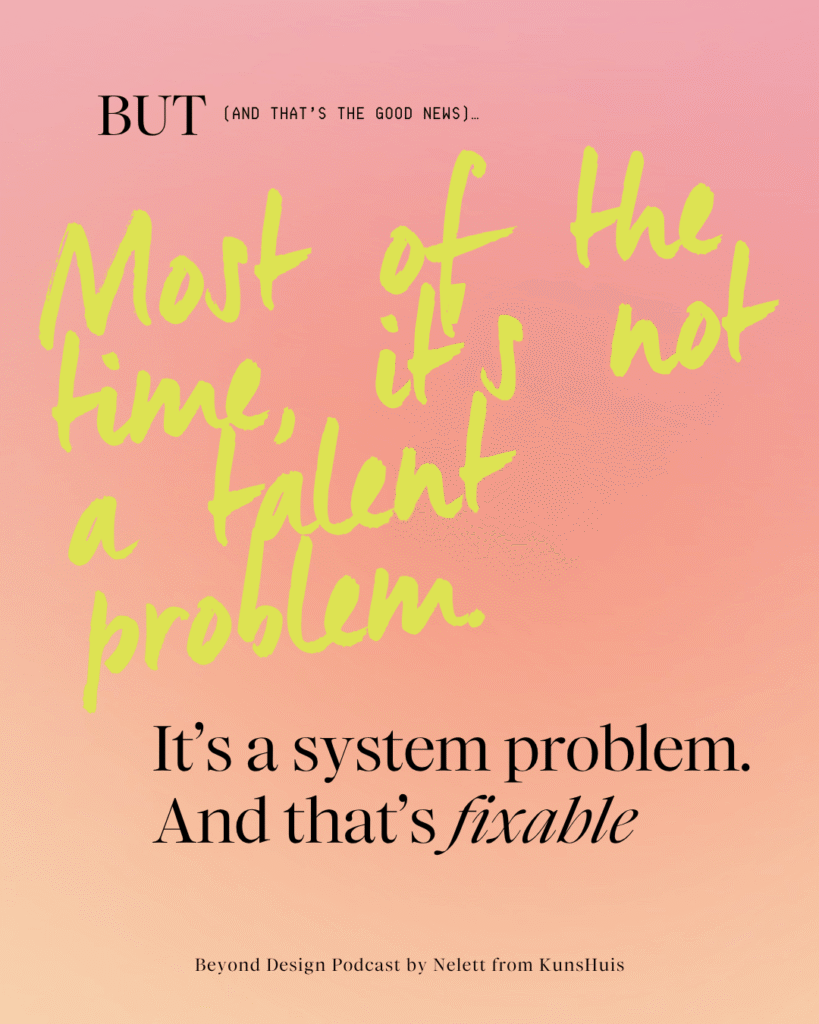
They’re just trying to build a business with only 20% of the tools.

Why clients “get difficult” (and it’s not always personal)
Here’s something I wish I knew earlier:
Most clients aren’t trying to control you.
They’re trying to feel safe.
If you don’t create structure, they will.
Not because they’re evil.
Because they’re human.
Humans look for certainty.
So if you’re not clear, they become pushy.
If you don’t have a process, they change their mind.
If you don’t set boundaries, they test them.
If you don’t explain what you’re doing, they assume you’re “just making it pretty”.
And then you start resenting them.
And now you’ve got a design problem and a relationship problem.
The 80/20 breakdown
Your talent might get you a client once.
But the other 80% is what makes them:
- come back
- refer you
- respect you
- pay on time
- trust you
So what is that “other 80%” really?
1) Communication
Not over-explaining.
Not disappearing.
Just being clear.
2) Boundaries
When you work.
How you work.
How feedback works.
What urgent costs.
3) Systems
A repeatable way of doing things.
So you’re not reinventing the wheel every job.
4) Confidence
Not loud confidence.
Quiet confidence.
The kind that shows in your emails.
The kind that doesn’t apologise for existing.
And yes — confidence is a practice.
Not a personality trait.
The real turning point: you train people how to treat you
This is the bit that stings a little.
But it’s also freeing.
Every time you answer after hours… you teach people you’re available.
Every time you say yes to extra work for free… you teach people your time is flexible.
Every time you deliver without a clear process… you teach people the work is magic, not strategy.
And then one day you wake up and realise…
You’re the designer.
The project manager.
The account manager.
The therapist.
The emergency department.
And you’re tired.
Not because you’re weak.
Because you’re carrying a business without boundaries.
Your practical takeaway: 5 non-negotiables
This is the part where you stop listening and start building.
I want you to write five non-negotiables for how you work.
Not how you wish you worked.
How you’re going to work now.
Here are examples you can steal and tweak:
Non-negotiable #1 — Working hours
“I reply to messages between _ and _, Monday to Friday.”
Non-negotiable #2 — Feedback rules
“I accept feedback in one place only (email / Notion / a form).
Not WhatsApp voice notes.”
Non-negotiable #3 — Revision limit
“This package includes _ rounds of revisions.
After that, it’s billed.”
Non-negotiable #4 — Payment boundary
“I start work once the deposit is paid.”
Non-negotiable #5 — No skipping steps
“I don’t skip the brief.”
Keep them short.
A non-negotiable is a sentence you can actually live.
After This Episode: mini-checklist
If you want this to land in real life (not just in your head), do this:
1) One decision
Decide your working hours.
Make it realistic.
Make it kind to your body.
2) One message you can send today
Copy/paste this:
“Hey! Just a quick note — to keep projects smooth, I reply to messages between _ and _.
If anything is urgent, pop it in the subject line and I’ll prioritise it.”
3) One small action
Write your five non-negotiables.
Put them somewhere visible.
Then add them to your onboarding or proposal.
Because when pressure hits, you forget what you promised yourself.
One more thing (if you want support while you build this)
If this episode hit a nerve, it’s probably because you’re ready.
Ready to stop winging it.
Ready to lead your work with more calm.
Ready to build the business side without losing your creative self.
I’m building something for exactly that:
Join the waitlist here: https://kunshuis.myflodesk.com/waitlist
No noise.
No pretending.
Just real support while you put the 80% in place.
If you’re sitting there thinking,
“I’m talented… so why am I still stressed?”
Because freelancing isn’t only design.
It’s people.
It’s clarity.
It’s saying the brave sentence.
It’s not replying to a WhatsApp at 22:00 just because you saw it.
You’re not failing.
You’re just growing into the version of you who leads the work.
And I’m right here with you.