





There’s a version of freelancing you see online. Laptop open, soft light, coffee next to you, good music playing. The dream. And then there’s the version you actually live.
The version where you read the same client email five times and still aren’t sure how to reply. Where you sit with a quote open for an hour, wondering if the number is too high or if you’re going to lose the job. Where you’ve done the thinking, done the design, made something you believe in — and then one email comes in and you’re suddenly questioning your whole career.
Not dramatic at all, I know. But it’s normal. It’s a Tuesday in every creative business.
And it’s the part we don’t talk about enough.
The Freedom Is Real. So Is the Silence.
We talk a lot about freelance freedom — the freedom to choose your clients, work from home, build your own thing, skip the morning traffic. And that freedom is beautiful. I mean it. I’m not here to take that away from anyone.
But there’s also a silence that comes with it. And sometimes that silence is lovely. And sometimes it starts talking back.
It sounds like: Am I doing this right? Is everyone else better than me? Should I charge for this, or do I sound rude? Is my work good enough? What if I mess this up?
When you’re alone, those questions get loud. And because there’s no one in the room to say “hey, that’s normal” — they get louder.
The Hard Part Often Isn’t the Design
I think for a lot of designers, the difficult part of freelancing isn’t actually the design. It’s carrying everything else alone.
The pricing decisions. The client conversations. The mistakes you sit with quietly. The wins that nobody celebrates with you because nobody’s there.
And then the small moments — the moment before you send the quote, the moment before you follow up on an invoice, the moment before you say no to a scope-creep request, the moment before you trust your own design instinct. Those moments are where things quietly get decided. And they’re a lot easier when you’re not the only one in the room.
What We Actually Need (It’s Not More Information)
Here’s the thing about information: we have plenty of it. The internet is full of PDFs and templates and courses and videos we save and never watch because life happens. Information is not the missing piece.
The missing piece is perspective. Someone to look at what’s actually happening and say:
“No, you’re not being difficult. You’re being clear.”
“Send that quote.”
“Don’t drop your price just because they asked once.”
“This concept is strong. You’re just tired.”
That last one especially. Sometimes the work isn’t bad. You’ve just been staring at it so long that nothing makes sense anymore. You’ve zoomed in and out of the same layout until your own eye can’t see it clearly. You’ve made tea three times and still haven’t made the decision.
That’s not a design problem. That’s what happens when you’ve been alone too long. And it doesn’t get solved by downloading another resource.
Small Questions Deserve Safe Places Too
There’s this category of question that doesn’t feel big enough for a formal coaching call — but it’s still sitting on your chest. You know the ones —
- How do I reply to this client?
- Is this feedback clear, or is the client just confused?
- Do I sound professional? Or do I sound desperate?
- Am I undercharging? Am I overexplaining?
- Should I add one more concept option?
These are not small questions. They feel small because you’ve been alone with them long enough that you’ve started second-guessing whether you’re even allowed to ask.
Most designers I know are skilled. They know what they’re doing. But they’ve been working alone for so long that they no longer trust their own voice. And that breaks my heart. Because you can be talented and still need people. You can be experienced and still need to ask a question. You can run your own business and still need someone to say, “I’ve been there too.”
Independence Has Been Made to Look Too Glamorous
We have somehow made it seem like asking for help means you’re not ready. That needing support means you’re not professional enough. That wanting community makes you less serious about your work.
That is nonsense.
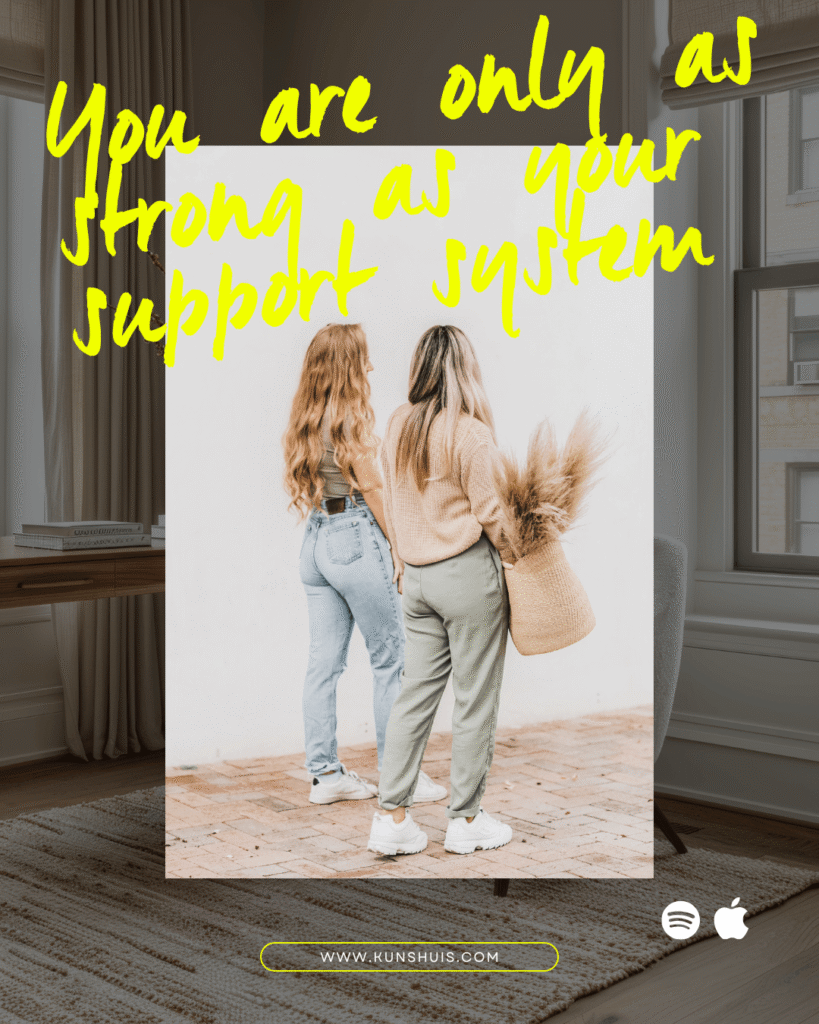
You are only as strong as your support system. The right people don’t make you dependent — they make you stronger. They remind you of what you already know when fear makes you forget.
I have a small WhatsApp group with creative moms. There’s no brand behind it, no strategy, no welcome-to-module-one. Just a handful of women who are creative, who are mothers, who are building things, trying to fit school runs and deadlines and supper and client emails into the same week without losing themselves completely.
We meet every two or three months in person. And every time I leave, my shoulders drop. Not because all my problems are solved — the emails are still there, the kids still need something five minutes after you sit down to work. But something shifts. Because I remember I’m not doing this alone.
What Real Community Actually Looks Like
Real community is not 284 unread messages and the need for a second coffee just to open your phone. That’s not support. That’s noise.
Good community should steady you, not drain you. It should give you room to show up without performing. A place where you can say “I’m struggling with pricing” and nobody makes you feel small. Where a newer designer can ask a basic question and not be embarrassed. Where an experienced designer can admit they still get nervous before sending big quotes.
Because they do. We all do. Experience doesn’t remove the fear. It just gives you more evidence that you can get through it. And sometimes you need to borrow someone else’s evidence until you have enough of your own.
Real community says: “Let’s look at the quote. Let’s read the email. Let’s separate the emotion from the decision. Let’s not make fear the business manager today.”
That is useful. That is the kind of support that actually changes things.
Community Helps You Take Up Space
When you’re alone, it’s easy to shrink. To charge less than you should. To over-explain every decision. To soften every email until your boundary has no backbone. To say yes when your whole body is saying no.
The right people help you stand a little straighter. Not louder. Just clearer.
And that’s what so many designers need right now. Not more advice shouted into the void. Just more of: “This is how I handled it — try it and see if it works for you.” More of: “You’re not alone in this.”
So If You’ve Been Feeling Lonely In Your Business Lately
Please hear this: it doesn’t mean you’re failing. It means you’re human.
You’re allowed to need people. You can be independent and still be supported. You can be the grown-up in the room, the one holding everything together, and still need someone to say, “Breathe. You’ve got this. Now reply to that email.”
Find your people. Maybe it’s one designer friend. Maybe it’s a small group chat. Maybe it’s a mentor, or a local coffee date once a month, or someone you can send a voice note to and just talk something through. But don’t build everything alone.
Creative work needs reflection. It needs conversation. It needs eyes. It needs other people who understand that this business isn’t only invoices and logos and deadlines — it’s also confidence, and doubt, and money, and emotion, and boundaries, and figuring out how to trust yourself while still being willing to learn.
That is a lot to carry alone. You don’t have to.
Links Mentioned in This Episode
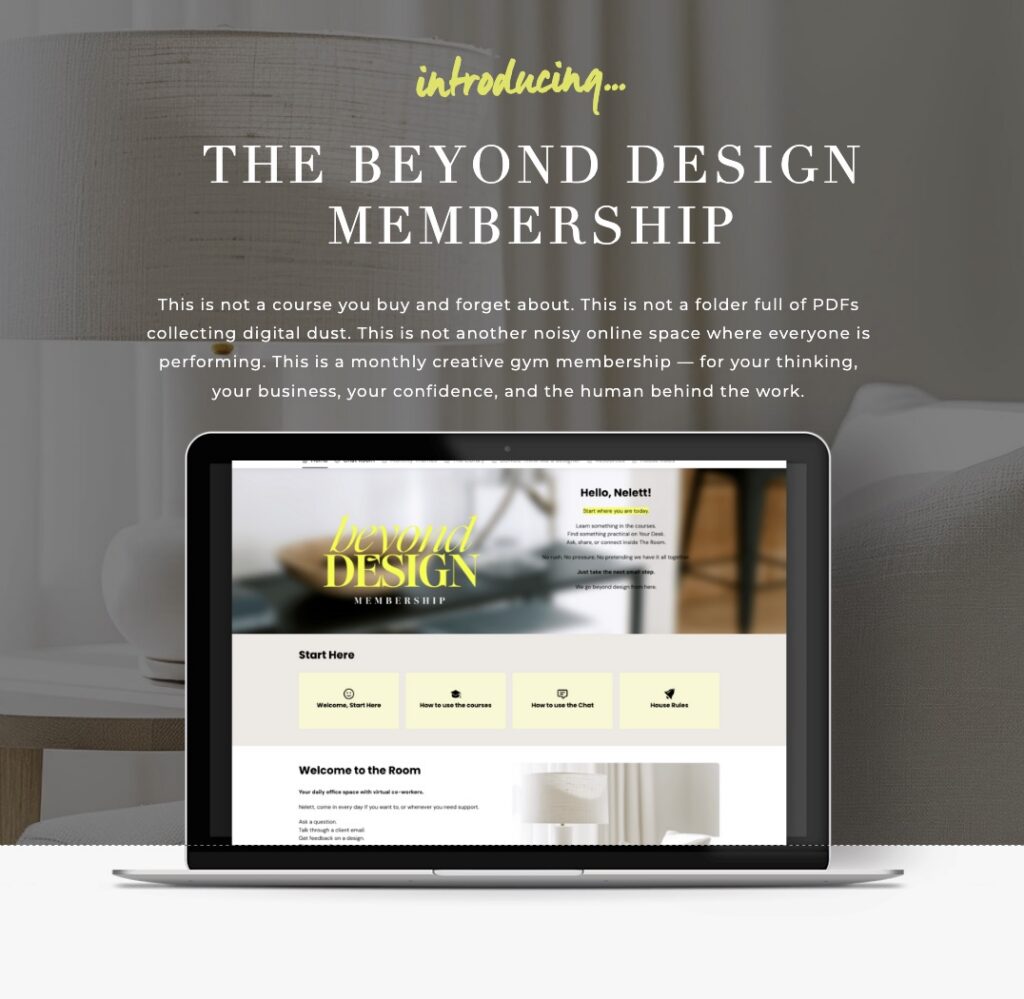
- Beyond Design Membership Waitlist → kunshuis.com/membership (Founding member rate now open — two full courses included in monthly membership fee)
Listen to More Episodes
The Beyond Design Podcast is for graphic designers, freelancers, and creatives who want more than design tips — it’s about building a creative life that actually works. New episodes drop weekly. Find Beyond Design on Spotify, Apple Podcasts, and anywhere you listen.
Hosted by Nelett Loubser — designer, creative life mentor, and founder of The Kunshuis Collective in Windhoek, Namibia.
© The Kunshuis Collective | kunshuis.com







BACK TO BLOG HOME