




Let me say the thing out loud, the thing most of us never admit: you’re not undercharging because you’re bad at maths. You’re undercharging because the money conversation makes your stomach drop. I know it did mine, for years.
So this one’s about how to price your freelance design work without giving it away. The short version, if you only read one line: stop pricing your hours, start pricing the value your work creates — and learn to ask a few brave questions before you ever say a number. That’s it.
The phone call that told me I was “doing it wrong”
Years ago, my phone rang. Another designer. “Nelett, you’re hurting the industry. You charge too little. You’re making the rest of us look bad.”
And I sat there thinking — how dare you.
Because they never asked me what I actually wanted. They just assumed we all wanted the same thing. The big studio. The big rates. The team, the office, the name on the door.
I didn’t want any of that. I wanted a studio that let me be creative, on my own time, in my own way, doing work I love. I needed enough — enough work, enough money to live the life I wanted. And I had it. I wasn’t hurting the industry. I was running my business to fit my life. Those are two very different things, and nobody gets to decide which one is right for you.
Then I had a baby, and everything changed
Here’s the part where pricing stopped being theory for me.
When my first son arrived, my whole model fell apart overnight. All those small, quick jobs that kept me financially strong — I couldn’t do them anymore. There simply weren’t enough hours with a newborn on my hip.
But I could do one big project. Priced well. Invoiced in stages, on a schedule, on my terms. And it clicked: project-based pricing, not hourly. Because hourly punished me for being fast and having less time. Then came my second baby, and even fewer hours — and project pricing didn’t just make sense anymore. It saved me.
Why pricing design work is so hard
Here’s the honest reason it feels impossible. We don’t sell a thing. We’re not a factory. There’s no “cost of materials plus a markup.” Service work is always an open target, because there’s nothing physical to point at and say, “that’s why it costs this.”
A client has to trust they’re paying you for a skill — same as they trust a plumber, a builder, an accountant, a photographer. You have a specialised ability. So how do you put a number on that?
You price it in value.
What “value” actually means (this is the whole game)
“Value” gets thrown around a lot, so let me tell you what I actually mean.
Value is the impact your work has after you’ve handed it over. It’s what your work keeps doing long after you’ve been paid and moved on.
Design a packaging, and the value isn’t the pretty label. It’s the shopper who spots it on the shelf, picks it up, buys it — and does it again, and again. That recognition becomes sales. Sales keep a business alive. That’s your work, still working, years later.
I’ve got logos and branding out there that clients are still using ten years on. Ten years of that business being recognised, trusted and chosen — off the back of something I charged, let’s say, N$2500 for. Ten years of value. For one small invoice.
Milton Glaser designed the I♥NY logo for free. Never took a cent — and it became one of the most recognised images on the planet. Carolyn Davidson designed the Nike swoosh as a student and was paid thirty-five dollars. Thirty-five. For a mark that now sits on billions of shoes. That gap — between the price and the value — is the whole thing. Stop seeing your work as “just” an hour of your time. Stop seeing it as less than.
So how do you actually price your work?
Right. “Charge for the value” is lovely, but it’s useless on a Tuesday when a client is sitting there waiting for a number. So here are the real steps — the ones I use, plus a framework from Chris Do (he runs The Futur, and he’s brilliant on this). His line: price the client, not the job.
Now, I’ve been pricing on value for almost ten years, so I know in my bones that it works. But there’s a difference between knowing something in your gut and being able to hand someone the actual steps to do it. So I did some digging — and this brilliant designer and businessman has these questions that stopped me in my tracks. Because reading them, I realised they’re exactly what I’d been doing all along. I just never had the words for it. So here they are.
Step one: ask questions before you give a number
The mistake most of us make is going straight to the number. Someone asks what a logo costs, and we panic and blurt something out. Don’t. Ask first. Get curious about their business instead of counting up your own hours.
Ask what they actually want to happen when you design the logo (as an example). Not “what do you need designed.” Ask them, “what do you want this logo to do for you?” Because nobody really wants just a logo. They want customers to trust them. They want to be the one people remember. Let them tell you that in their own words.
Ask how they’ll know it worked. Is it more sales? More people getting in touch? Or is it that they finally look good enough to charge properly? Whatever it is, let them say it out loud. Not you.
Ask what that’s worth to them. This is the scary one, and I know it. But you just say: “so if this brought you even ten new customers a month, what would that do financially for the business?” And then you stay quiet. And they’ll tell you. Now there’s a number in the room, and you didn’t invent it. They did.
Price against that number. Chris Do says a fair cut sits somewhere around ten to twenty percent of the value you help create. Which I love, because now you’re not guessing. You’re taking a fair slice of the money you’re about to help them make. That’s not cheeky. That’s fair.
Step two: how I actually land on the number
You’ve asked your questions. Now here’s what goes on in my head every single time.
Work out your floor — but keep it to yourself. I know a logo takes me around eight hours. Eight hours times my rate gives me the number I won’t go under. That one’s just for me. The client never sees it.
Quote one price for the whole job. Never per hour. Because the minute someone sees an hourly rate, they start watching the clock and wondering why it took you six hours and not four. And then you get punished for being quick, which is mad, because being quick took you years to learn.
Check the value, and read the person in front of you. What is this going to keep doing for them long after I’ve moved on? And who am I talking to here — a big client with proper budget, or a small start-up with more heart than money? I go up, or I come down. There’s feeling in that, and a bit of strategy. That’s allowed. That’s the job.
Give them three options, not one. A small way in, a middle one, and the proper full thing. Because now they’re not deciding yes or no. They’re deciding which one. They get to feel in control of it. And I’ll tell you now, they almost never pick the cheapest.
Take a deposit, then invoice in stages. You’re not a bank. Get paid as you go.
And when they say “that’s a lot” — don’t drop your price. Someone always says it. And dropping your price is the worst thing you can do, because it tells them the first number was made up. Explain the value again instead. Or if you really have to, take something out of the job. Less work, not less money. You never cut your price. You cut the scope.
A fun pricing style to try: DESIGN DAYS
The one I’ve never actually done yet, but I really want to. Design days.
Okay, so here’s how it works. You clear your whole diary for one day. And this is the bit I love — they clear theirs too. You in your office, they in theirs. So it’s one client, one full day, and you’re both properly there. Which means when you’ve got a question, they answer it. Right then. Not in three days when they finally get round to checking their emails.
You start in the morning, you work through the thing together, and by the end of the day they’ve got their project. Done. Finished.
Not for big projects but smaller ones like flyers, car branding etc.
And they pay you before you hand it over. That’s it. It’s like walking into a shop and walking out with the milk. You pay, you take it home, off you go. No invoice chasing. No “just following up on that payment” email in three weeks.
No dragging a job out for six weeks. No back-and-forth for a month. No “just checking in!” at half nine at night. You book the day, you do the work, you get paid, and it’s done.
It’s clean. It’s a little bit glamorous, if I’m honest. And it’s proper money without the slow long project. That one’s going straight to the top of my list, and I think it should be on yours too.
The bit that glues it all together (every time): communication
This is the part that holds all of it up. Don’t go quiet. When you’re pricing, when you’re working, when there’s a delay — talk. Show your thinking. Explain the why. Educate your client gently, the whole way along. Silence is where trust falls apart. Show up and explain, and the price stops being a fight.
Nobody taught us this at design school, did they. We work with business people every day — we need to know how business thinks. Design and business should walk hand in hand. So we’re saying it here.
The tool I wish I’d had when I started
I’ve done the guessing for you. Twenty-five years of it — the mispriced jobs, the awkward money chats, all of it — packed into tools so you don’t have to learn it the slow way.
In August I launch the Studio Desk, and there’s a finance section in it I’m almost too excited about. It’s where you sit down and work out your price. And I want to be clear about what this is, because it matters: it’s not a generic calculator off the internet, and it’s not average numbers scraped from strangers who don’t do what you do. It’s my method — the exact way I price, everything on this page, built in and ready to use.
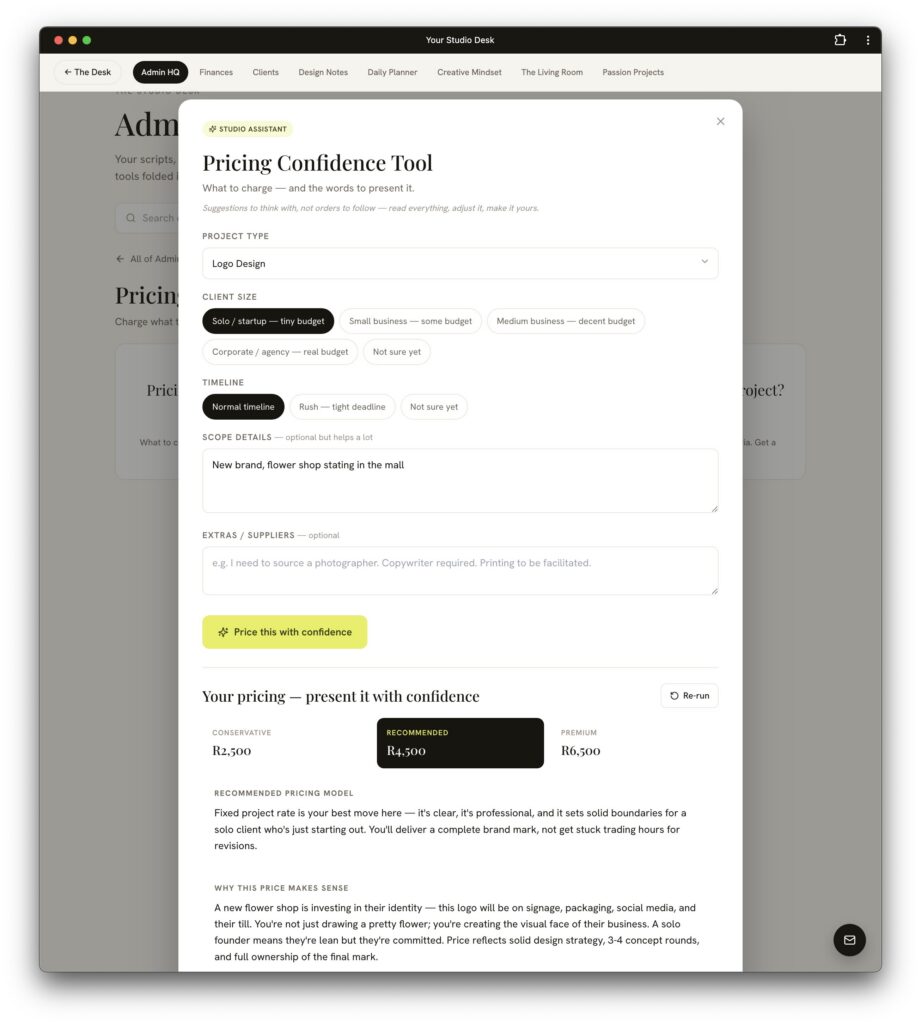
There’s a piece inside it I’m especially proud of. You give it the brief, and it gives you instant feedback on how to price it. And please hear this properly: that’s not some general tool telling you what “the market” says. It’s me — my work, my knowledge, my twenty-five years, my gut, my words — built in. Like having me sit next to you while you quote, going “yes love, that feels right” or “no, you’re going too low again, lift it.” Instant. In your corner. Based on how I’d actually do it.
There’s the digital planner too, and the membership coming later this year or early next — where we go properly deep on all of this. This episode is the front door to it. The Business Side of Design is where the rest lives.
TL:DR
- Ask what they want to happen, how they’ll measure it, and what it’s worth to them.
- Price the client, not the job — aim for a fair slice of the value you create.
- Know your hourly floor privately; only ever quote one project price.
- Offer three options and let them choose.
- Take a deposit, invoice in stages.
- Never cut your price — cut the scope.
- Communicate the whole way through.
FAQ
How much should a freelance designer charge? There’s no single number, and any guide that gives you one is lying to you a little. Rates vary wildly by experience, market and project. That’s exactly why value matters more than a rate card — price what the work is worth to that client, not what feels “not too expensive.”
What is value-based pricing? Charging based on the impact your work creates for the client — the sales, leads or recognition it brings — rather than the hours you spent. It’s the difference between selling your time and selling a result.
Should I charge hourly or per project? Work out your rate hourly if you like — privately, just to know your floor. But quote a single project price. Hourly pricing punishes you for being fast and invites clients to nickel-and-dime you.
How do I stop undercharging? Ask better questions before you quote, price against the value the client names, offer options, and stop dropping your price the second someone flinches. And practise. Confidence in the money conversation is a skill, not a personality trait.
Enjoyed this one? Leave a review and subscribe — it’s a small thing, but it’s how another designer finds this and feels a little less alone in it. And if you want the tools, get on the Beyond Design membership waitlist.
Remember: it’s not difficult. It’s small things, done right, consistently.







BACK TO BLOG HOME