




I once spent four hours arguing about a shade of blue.
Not a metaphor. Four hours. Two blues, maybe six per cent apart. At the end we picked the first one. Everyone was tired and slightly cross, and I drove home having been paid quite well to referee a fight about nothing.
Took me years to work out what actually happened in that room.
We weren’t arguing about blue. We were arguing because nobody could say what the brand was, so every decision had to be settled on taste. And taste is unwinnable. You can’t out-argue someone’s taste. You can only outlast it, and by hour three everyone’s lost the will and the good idea has died somewhere near the biscuits.
Here’s the fix, and it’s almost annoyingly simple.
Stop trying to design a brand. Cast a person, and let them decide.
What is a brand, if it isn’t a logo?
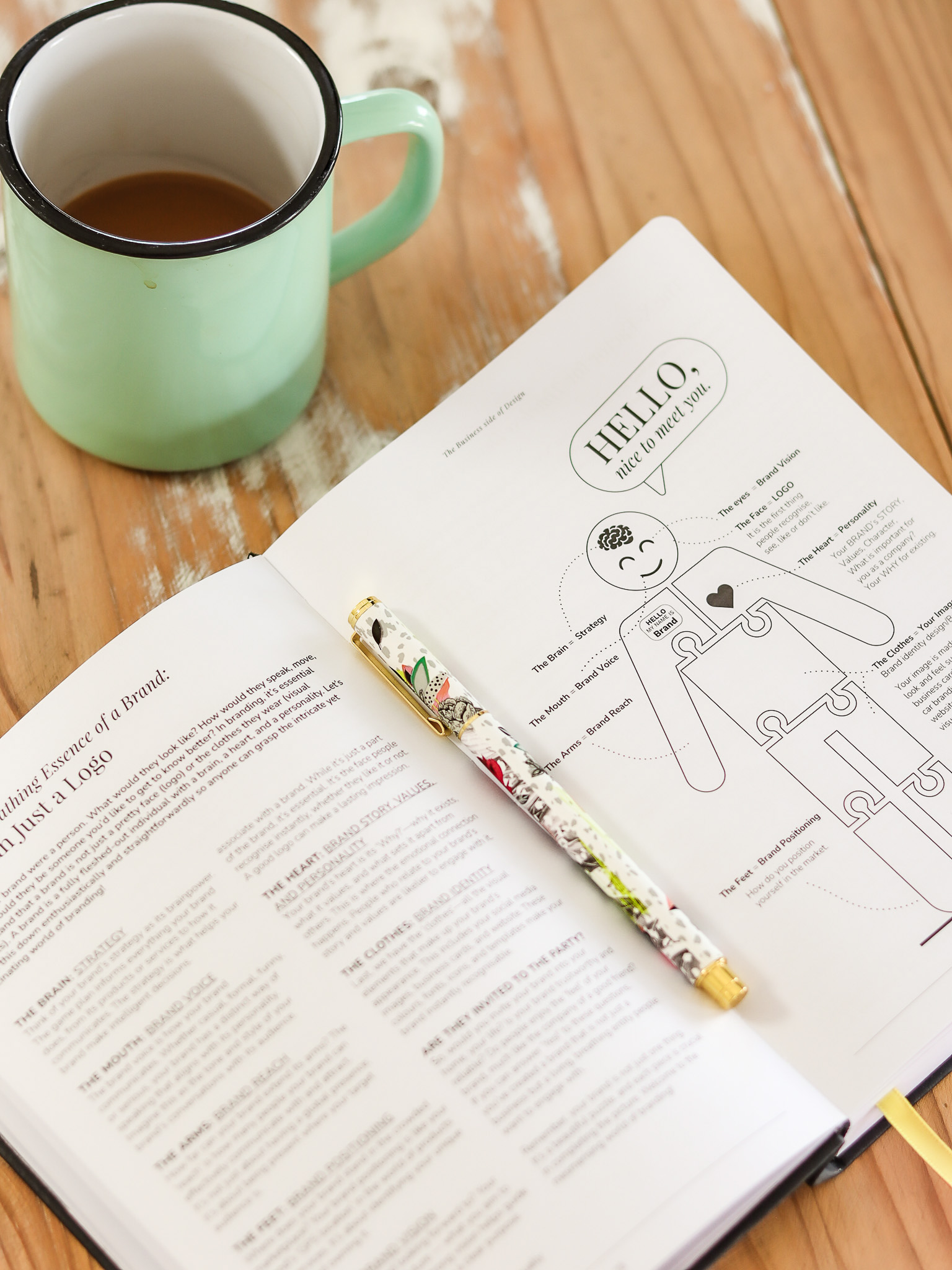
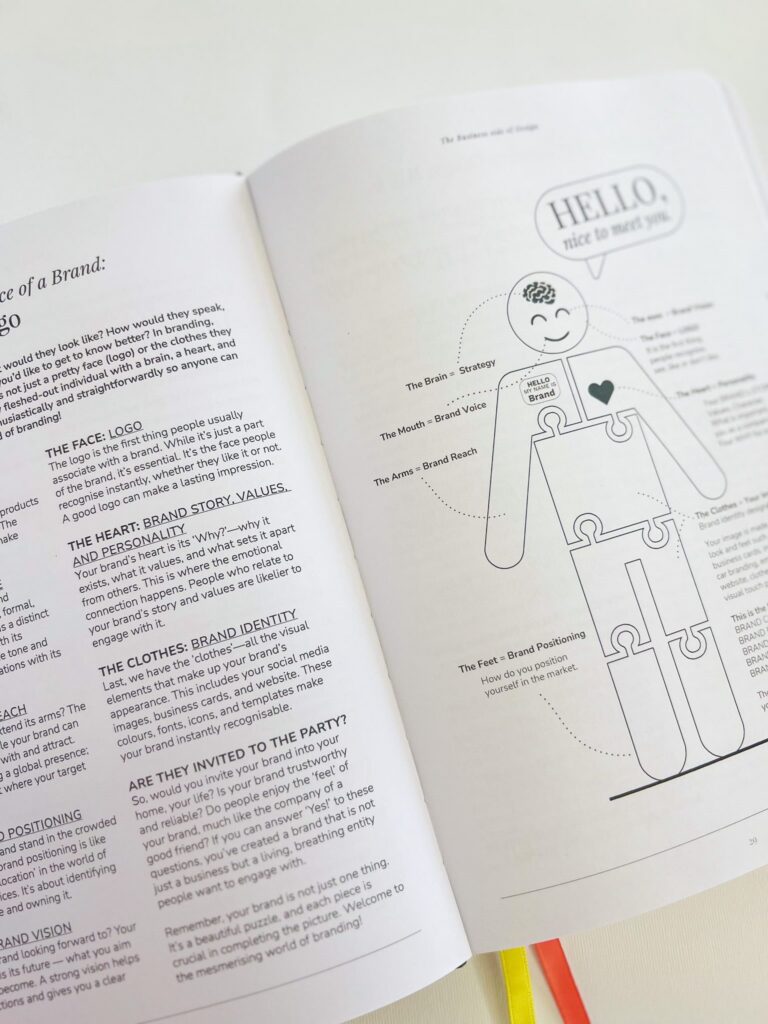
A logo is the face. A brand is the whole person — the strategy behind it, what it’s looking towards, how it speaks, what it cares about, how far it reaches, what it wears, and where it stands in the market. The logo is one of eight parts, and it’s the last one you should design.
That’s not a nice way of putting it. It’s the actual reason so much brand work fails.
Most people come to a designer wanting a logo. A lot of the time the logo isn’t the problem, which is why the same clients turn up eighteen months later with the same problem wearing a nicer outfit. They didn’t know who they were. Somebody handed them a face without a person behind it.
I know because for a long stretch of my career, that somebody was me.
How do you define a brand personality?
Pick one real person and describe them in detail — what they wear, how they speak, what makes them cross — then let that person make your design decisions. It works because nobody can answer “what should our tone of voice be,” but everybody can answer questions about a human being.
Right. Practical, and I’d like you to actually do this rather than nod at it.
Get a picture of a human. Not a moodboard. One person. An actor, someone you know, a stranger from a photo, that woman from the deli who is very obviously a Ruler and knows it.
Print them out. Stick them on the wall where you’ll see them.
Now be nosy.
What are they wearing? Not “elevated minimalism.” What’s the actual coat? Is it new, or fifteen years old and better for it? Do their shoes look expensive or comfortable — and would they be embarrassed if you noticed the difference?
How do they answer the phone? First ring or fourth? “Hello,” or their own name? Do they send voice notes at eleven at night?
What’s in their bag? Everyone’s brand is in their bag. Three pens, a receipt from 2019 and a spare charger is a completely different brand from one beautiful notebook and nothing else.
Do they arrive early or late? And are they sorry about it?
What do they order? The usual, or the strange thing on the specials board?
What would make them properly cross? Not mildly irritated. Actually cross. This one tells you more than the other five combined.
That’s the whole trick. You’ve swapped a design question, which is unanswerable, for a social one — and humans are extraordinarily good at reading other humans. Your client has been doing it since nursery. They’re an expert at this. Let them be one.
What are the 8 parts of a brand?
A brand has eight working parts: strategy (the brain), vision (the eyes), logo (the face), voice (the mouth), personality(the heart), reach (the arms), identity (the clothes) and positioning (the feet). Most brand projects design the face first and skip the rest.
Once you’ve got your person on the wall, each part becomes a question you can actually answer.
The Brain — strategy. What’s this person’s game plan? Not a mission statement. What are they trying to pull off?
The Eyes — vision. What are they looking at? And would they admit it out loud, or is it a private ambition?
The Face — logo. What do people clock first? The smile, the haircut, or the fact that they’re slightly overdressed for the occasion?
The Mouth — voice. Do they swear? Do they apologise a lot? Are they funny on purpose or by accident? Would they ever use an exclamation mark, and how would they feel about it afterwards?
The Heart — personality. What do they actually care about? The thing they’d get properly boring about at a dinner party.
The Arms — reach. Who do they hug, and who gets a handshake? Everyone they’ve ever met, or three people very well?
The Clothes — identity. Now you can do colours and fonts. Now. Not before. And it’s easy, because you’re dressing someone you already know.
The Feet — positioning. Where do they stand in the room? Middle of it holding court, or by the kitchen door where the good conversations happen?
Eight questions. Twenty minutes. Nobody said “brand essence” once.
What are the 12 brand archetypes?
The 12 brand archetypes are recurring character types — Creator, Caregiver, Ruler, Everyman, Jester, Lover, Outlaw, Hero, Magician, Innocent, Sage and Explorer — used to give a brand a consistent personality. They come from Jung’s work on archetypes, adapted for branding by Margaret Mark and Carol Pearson in The Hero and the Outlaw.
They’re the casting director’s cheat sheet.
Used badly, they’re a horoscope. Do the quiz, you’re The Magician, feel briefly seen, put it on a slide, change nothing.
Used well, they’re twelve people you already know how to write.
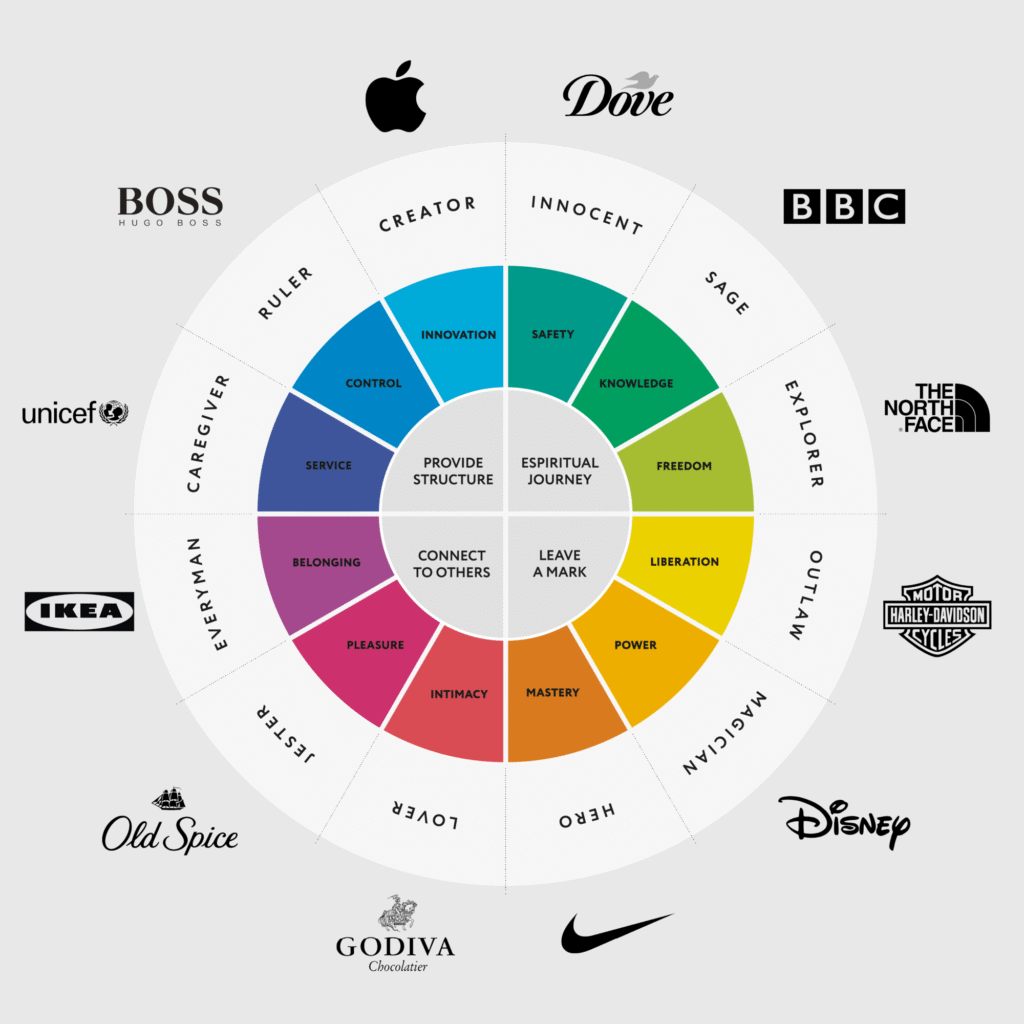
The four families are the useful part. Provide structure and evoke exploration pull in opposite directions — one’s offering safety, the other’s offering the precise opposite of safety.
So when a client says they want to feel like Rolex and like Patagonia, you haven’t got a brief. You’ve got two briefs and a small problem. Spotting that in week one rather than week six is worth actual money.
How do you use a brand archetype in practice?
Use it as a filter, not a label. Before any design decision, ask whether that character would do it — the archetype rules options out fast, which is the job. It also works as a brief, and as a way to find the gap in a crowded category.
Here’s where it stops being an exercise.
They kill options. The Sage doesn’t use an exclamation mark. The Outlaw never apologises in their copy. The Caregiver would rather die than run a countdown timer. These aren’t rules I’ve invented — they fall straight out of the character, and they settle arguments in about four seconds. Which is three hours and fifty-six minutes faster than blue.
They become the brief. “She’s The Magician with a bit of Sage in her, she’d never shout, and she’s always slightly overdressed” tells a designer more than three pages of adjectives. If you’re the designer, get your client to that sentencebefore you quote. You’ll price the job properly, because you’ll finally know what you’ve agreed to.
They show you the gap. Sort every competitor in the category. If eleven of them are Heroes — and they usually are, because Hero is where everyone runs when they’re nervous — the interesting answer isn’t a twelfth Hero. It’s a Jester in a serious room. Same market, completely different territory, twenty minutes’ work.
They stop you designing by committee inside your own head. You know that thing at eleven at night where you’ve got two versions open and genuinely cannot tell which is better? Ask her. She’s on the wall. She’ll tell you.
Can a brand have more than one archetype?
Yes, and the good ones usually do. Most brands have a dominant archetype with a second one underneath, and the tension between the two is where the personality actually lives. Apple is a Magician with a Creator in the back. Take either one away and it gets boring immediately.
So don’t flatten your person into one word. That’s how you end up with something consistent and completely dead. Technically correct, nobody home.
Is a brand archetype the same as brand strategy?
No. An archetype is a shortcut into strategy, not a replacement for it. You still need to know who’s buying, what the business actually sells, and what it’s like to deal with them on a bad day. The archetype makes those conversations faster and stops them turning into arguments about taste.
Anyone selling you an archetype as a finished strategy is selling you a horoscope with an invoice attached.
How do you find your brand archetype?
Take a brand you’re working on — a client’s, or your own — and give it twenty minutes.
- Find your person and stick them on the wall. An actual picture. Yes, really.
- Answer the six nosy questions. Coat, phone, bag, punctuality, order, what makes them cross.
- Name three things they’d never do. The nos are worth more than the yeses.
- Take the decision you’ve been going round in circles on — and ask her.
That’s a strategy. Not a complete one. But a real one, and considerably more than most brands ever get.
I still think about that blue. Mostly because everything I know about this started in that room, being paid to argue about nothing, watching two perfectly reasonable people fail to describe somebody neither of them had ever met.
Go and meet yours.
Not sure who you’re working with? Meet Brand — he’s a puzzle in eight parts, and at the end you’ll find out which of the twelve is standing in front of you. Five minutes, and you get to stick your own logo on his face.








BACK TO BLOG HOME